
EXPEDITED

AEROSPACE
AOG, Explained
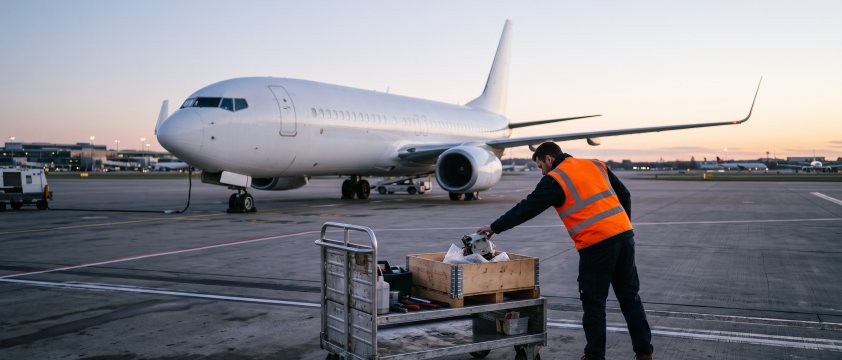
AOG stands for Aircraft on Ground. It means an aircraft cannot fly until a specific fault is fixed, usually a part that has to be found, moved, and fitted.
That is the definition. It is also the least useful thing about the term.
What matters operationally is that AOG is a priority classification, not just a description. Once a shipment is tagged AOG, it outranks nearly everything else in the aviation supply chain. The reason is that the cost of the grounded aircraft dwarfs the cost of almost any action taken to un-ground it.
The classification matters more than the vocabulary. An aircraft is either airworthy or it is not. That line is legal, not editorial: federal airworthiness rules bar operating a civil aircraft that is not in an airworthy condition.
A delay can be managed with a schedule. An AOG cannot. There is one fix, it needs one specific part, and every hour until that part is fitted is an hour the aircraft is not earning.
What AOG actually costs
Direct costs first, though they are the smaller half:
- The aircraft earns nothing while grounded
- Crew is on the clock, and eventually times out under duty limits
- Passengers are rebooked or compensated
- A maintenance slot booked elsewhere may be lost
Then the compounding half, which is what makes AOG different from ordinary downtime. An aircraft is a node in a rotation. Ground it and the next flight it was supposed to operate is now short an aircraft, and so is the one after that. A single AOG in the morning can cost several cancellations by evening. This is why an operator will pay for a dedicated truck to carry one component: they are not comparing it to standard freight, they're comparing it to a cancelled rotation.
A useful rule of thumb: if choosing the cheaper transport option adds hours, it is almost never the cheaper decision.
What triggers an AOG
- A component fails in service or is found unserviceable during inspection
- A scheduled check turns up something that wasn't planned for
- A part arrives and is wrong, damaged, or missing paperwork
- A required tool or piece of ground support equipment isn't at the station
- A life-limited part reaches its limit earlier than the plan assumed
The last two are worth naming, because they're the ones people forget when they think "AOG = broken part". An aircraft grounded for want of a tool is grounded exactly as thoroughly.
How an AOG part actually gets moved
The decision is always the same shape: which option puts the part in the engineer's hands soonest, not which option is fastest in the abstract.
Dedicated ground. One vehicle, one driver, straight through. Predictable, because arrival is drive time plus fuel stops, and there is no schedule to miss. On a lane under roughly 500 miles this usually beats flying once you count tender cut-off, terminal handling, and recovery at the far end.
Next Flight Out. The part goes on the first available commercial flight. Fast in the air, but bracketed by ground time at both ends: it has to reach the origin terminal before cut-off, then be recovered after landing. On long lanes it wins clearly.
Team drivers. Two drivers alternating so the vehicle never stops. Turns a two-day drive into roughly one. The right answer on long domestic lanes where flight timings are poor.
Airport recovery, the step people forget. A part that has landed has not arrived. It is in a cargo terminal that has its own release process, its own hours, and its own queue. Hours disappear here routinely, on shipments that "arrived" first thing in the morning. Somebody has to be there to collect it and drive it to the hangar, and airport recovery should be arranged before the aircraft lands, not after.
Ground, next flight out and a team run are not ranked options. They are lane-specific answers, and the honest one changes with that day's flight schedule. BMA runs all three, plus collection at the destination airport. That makes it one call rather than three.
Where AOG shipments lose time
Four places, in rough order of how often we see them:
- The handoff gap. Ground carrier, airline, recovery agent, final delivery, each one waiting for the previous to finish before starting. The fix is one party owning the shipment end to end.
- Terminal release. See above. Predictable, and therefore preventable.
- Customs on a cross-border move. Documentation prepared after dispatch instead of before it. A truck sitting at a crossing is not moving.
- Choosing air on reflex. Air feels faster. Over shorter distances it frequently isn't, once the ground legs at both ends are counted honestly.
Common questions
What does AOG stand for?
Aircraft on Ground. An aircraft that cannot be returned to service until a specific fault is corrected, normally a part that must be sourced and delivered.
Is AOG the same as a delay?
No. A delay is a schedule problem. AOG is a serviceability problem: the aircraft is not legally or technically airworthy until the fix is made, and no amount of schedule juggling changes that.
How fast can an AOG part be delivered?
Dispatch on a dedicated vehicle is usually within the hour. After that it's physics: drive time, or flight schedule plus terminal release. Anyone quoting an arrival time without asking where the part is and where it's going is guessing.
Air or ground for an AOG part?
Whichever lands first, which is not always the one that looks faster. Under ~500 miles, dedicated ground usually wins. Longer than that, next-flight-out or team drivers. The honest answer depends on the specific lane and the flight schedule that day.
What is AOG in aviation supply chain terms?
The highest priority classification a shipment can carry. It authorises expedited handling and premium transport because the cost of the grounded aircraft exceeds the cost of moving the part almost without exception.
Who handles AOG logistics?
Specialist expedited carriers rather than general freight networks. The difference is 24/7 coverage, dedicated vehicles, and the ability to recover a part at the destination airport rather than leaving it in a terminal.
Where this shows up in real operations
An AOG desk rarely gets a clean brief. The part number arrives as a photograph of a label. The aircraft sits at a station that holds no spares. The person who can authorise the movement is in another time zone.
What separates a six-hour recovery from a twenty-hour one is almost never the transport. It is how fast the part is physically located, and how early the carrier is given a deadline rather than the word urgent.
What that means for the cost of the stoppage: the transport premium is a fixed number, quotable before anyone commits to it. The cost of the grounded aircraft is not fixed. It is the one that keeps growing while the decision is discussed. In most recoveries those two numbers get compared too late, after the cheaper option has already cost more than it saved.
[ KEEP READING ]
More from BMA Express.

MANUFACTURING